Inside a project recovery: the first seventy-two hours that matter most

A program recovery does not begin with a new plan, a new budget, or a new team. It begins with a controlled reset of three things — scope, evidence, and stakeholder positions. The first seventy-two hours determine whether that reset is possible, or whether the project will spend the next six months trying to recover from its own recovery.

Shahid Qaisrani, PgMP, PMP

2026-05-09

72-hours-recovery_hero
The moment a program is declared to be in recovery is the moment its trajectory becomes most fragile. Information has stopped flowing reliably, decisions are being made on the basis of competing narratives, vendors and partners are reading the room and adjusting their own positions, and the executive team is under pressure to demonstrate immediate progress. Every one of these dynamics works against a coherent restart. The recovery has a window — short, specific, and unforgiving — in which a new operating reality can be installed before the existing one hardens around the new uncertainty.

That window is, in practice, the first seventy-two hours. What happens inside those three days is not the recovery itself; it is the precondition for the recovery. Get it right and the program has a structural basis for stabilization. Get it wrong and the next six weeks will be spent re-litigating decisions that should have been settled on day one.

70%

of struggling IT projects can be successfully stabilized when intervention begins within the warning-signs window.
PMI Pulse / Standish CHAOS, 2024

5–10×

cost differential between problems addressed early versus problems addressed late in the execution phase.
Boehm, IEEE, 1981

48 hrs

empirical window before stakeholder positions harden and the available recovery options narrow materially.
IT Delivery Assurance internal, 2025

Hour 0–24: the scope freeze

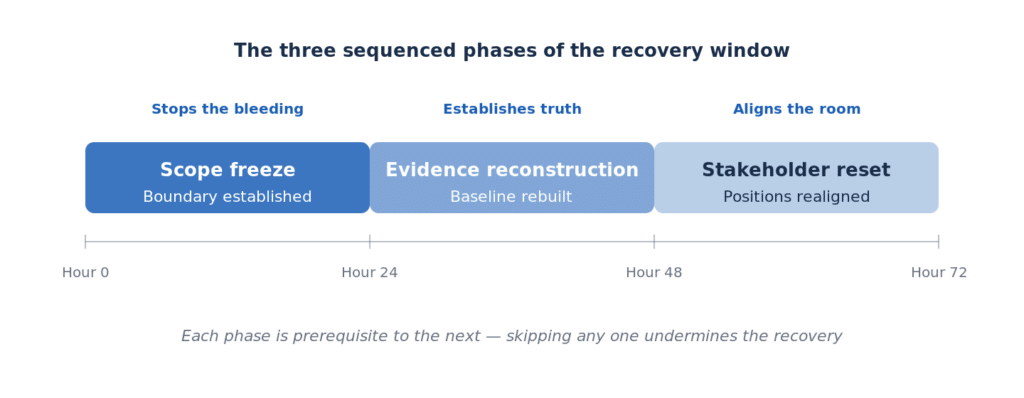
The first action of a recovery is not investigation. It is a scope freeze. A program in recovery is, by definition, a program where the relationship between commitments and capacity has broken down. New scope cannot be absorbed; existing scope is already under pressure. Yet in the absence of a formal freeze, change requests continue to enter the program, dependencies continue to shift, and stakeholder expectations continue to expand. Each of these is reasonable from the perspective of the individual stakeholder making the request. Together, they are fatal to recovery. The freeze stops the bleeding.

The freeze does not need to be perfect. It needs to be explicit, communicated to every workstream lead, every vendor with an active commitment, and every governance body with the authority to introduce change. It declares that for a defined period — typically four to six weeks — no new scope will be accepted, no existing scope will be expanded, and no commitments will be made against capacity that the program does not currently have. The freeze gives the recovery team something it has not had for some time: a stable boundary.

Done properly, the scope freeze takes most of the first twenty-four hours. Most of that time is communication. The freeze that is announced once and never repeated is the freeze that erodes within seventy-two hours. The freeze that is restated daily for a week is the freeze that holds. Once the scope is frozen, the next priority is establishing what is actually true.

A program in recovery typically has multiple, partially overlapping versions of its delivery position — what the steering committee was last told, what the workstream leads believe, what the vendors are operating against, what the technical team observes in the system itself. Each of these is partial. None of them, on its own, supports a defensible plan forward. The evidence reconstruction is the disciplined process of consolidating these into a single, evidence-based position that everyone can act on, regardless of where they were positioned before the recovery was called.1

The reconstruction has a specific structure. It begins with the artifacts — the plan, the dependency map, the RAID log, the milestone list, the financial position — and tests each one against the latest direct observation. Where the artifact and the observation disagree, the artifact is provisionally suspended pending resolution. The output is not a new plan; it is a credible baseline against which a new plan can be built. The baseline is shared in writing within forty-eight hours of the recovery being declared.

The discipline of this phase is the refusal to skip ahead. Recovery teams that try to produce a new plan before the evidence base is reconstructed will produce a plan that perpetuates the assumptions that caused the original failure. The forty-eight hours spent establishing what is true is the most valuable forty-eight hours of the recovery.
Figure 1. The structured sequence of activities across the seventy-two hour recovery window — scope freeze (0–24 hours), evidence reconstruction (24–48 hours), and stakeholder reset (48–72 hours) — each prerequisite to the next. Source: IT Delivery Assurance methodology, 2025.

"The forty-eight hours spent establishing what is true is the most valuable forty-eight hours of the recovery."

PMI Pulse of the Profession (2024) and Standish Group CHAOS Report (2023). Combined recovery-success analysis. Across the two studies, projects identified as in trouble and subjected to formal intervention within the warning-signs window achieved stabilization or partial recovery in approximately 70% of cases, compared to 30% when intervention came after that window had closed.


Hour 48–72: the stakeholder reset

With scope frozen and evidence consolidated, the third priority is resetting the stakeholder map.

A program in trouble produces specific stakeholder dynamics: sponsors who feel insufficiently informed, vendors who sense leverage, business owners who have begun to plan around the program’s failure rather than its success, and project staff who have absorbed months of pressure without being given a workable plan. These dynamics, left unaddressed, sit underneath every meeting and every decision the recovery team will try to make. The reset is the structured process of acknowledging where each stakeholder currently sits, what they currently expect, and what the recovery is and is not committing to in the new baseline.

The reset is not a single meeting. It is a sequence — beginning with the executive sponsor, moving through the workstream leads and key business owners, and concluding with the principal vendors and partners. Each conversation has the same three components: an honest description of where the program now sits, an explicit description of the scope freeze and what it does and does not mean, and a clear statement of what the next four weeks will produce and what they will not. The honesty is the load-bearing element. Stakeholders who feel they have been given the real position will work with the recovery; stakeholders who suspect they are being managed will undermine it.

The reset closes the seventy-two hour window with a program that has been formally restarted on a new basis — frozen scope, established evidence, aligned stakeholders — even though the new plan has not yet been written. The plan that follows is built on solid foundations rather than dragged out of the ruins.
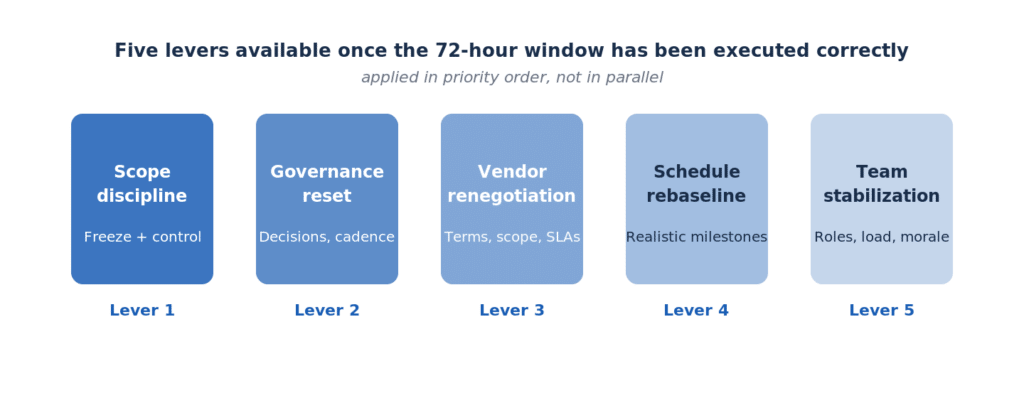
Figure 2. Five levers a recovery program can pull once the seventy-two hour window has been executed correctly — scope discipline, governance reset, vendor renegotiation, schedule rebaseline, and team stabilization. Source: IT Delivery Assurance methodology, 2025.

What this looks like when it works

Boehm, B. (1981). Software Engineering Economics. IEEE Computer Society. The classic finding that the cost of correcting a defect or scope problem grows approximately 5–10× across each successive phase of the delivery lifecycle has been repeatedly confirmed by subsequent industry studies and remains the most-cited empirical basis for early intervention economics.
IT Delivery Assurance internal analysis (2025). Across recovery engagements observed and led between 2018 and 2025, stakeholder positions were observed to harden on a 48–72 hour timeline once a program was publicly identified as in trouble. Recoveries that completed the scope freeze, evidence reconstruction, and stakeholder reset within that window achieved measurably higher stabilization rates than recoveries that extended the reset period beyond it.

References

1. Project Management Institute (2024). Pulse of the Profession 2024. Newtown Square: PMI.
2. Standish Group (2023). CHAOS Report 2023. West Yarmouth: Standish Group International.
3. Boehm, B. (1981). Software Engineering Economics. IEEE Computer Society.

Related insights

Continue reading

IT Delivery Assurance
9 min read
2026-05-09
IT Delivery Assurance
8 min read
2026-05-09