When to act on a vendor: before renewal, not after

Waiting until contract renewal to confront a vendor's underperformance is the weakest leverage position a buyer can adopt. The right moment to surface, document, and act on vendor performance issues is roughly the midpoint of the contract — when both parties still have a working interest in the outcome and the cost of acting is materially lower than the cost of waiting.

Shahid Qaisrani, PgMP, PMP

2026-05-09

vendor-renewal_hero
There is a recurring pattern in how enterprises manage vendor performance on critical IT contracts. Issues surface during the contract term. They get documented in monthly governance reports. They get escalated, partially. They get tolerated. And then — at renewal time, often within sixty days of the renewal window opening — the buyer attempts to use the accumulated body of performance issues as leverage to reset terms, reduce price, or, in some cases, exit the relationship entirely. The leverage almost always disappoints. The vendor has had eighteen months to absorb the criticism, to position counter-narratives, and to reorganize internally to make replacement costly. The buyer arrives at the negotiation in a structurally weakened position.

The pattern is not driven by inattention. It is driven by a cultural reluctance to escalate vendor relationships during the term — a sense that bringing in formal assurance, contract counsel, or performance challenge will jeopardize the day-to-day working relationship. That reluctance is understandable, and it is also expensive. The leverage window for meaningful vendor action sits roughly at the contract midpoint, not at the renewal cliff. Acting earlier produces materially better outcomes for both parties.

65%

of organizations report that vendor underperformance materially affects critical IT program outcomes.
Gartner / IDC, 2024

2–3×

the leverage available at mid-contract versus at the renewal point on a multi-year IT contract.
Forrester Vendor Risk, 2023

18 mo

typical lead time required to replace a critical vendor on an enterprise IT contract.
IT Delivery Assurance internal, 2025

Why renewal is the wrong leverage point

The standard argument for waiting until renewal is that renewal is the moment the buyer has obvious commercial leverage. The contract is up; the vendor needs the buyer to re-sign; therefore the buyer is in the strongest negotiating position. The logic is intuitive. It is also wrong, and the reasons it is wrong matter for how vendor performance should actually be managed.

The first reason is that renewal leverage assumes a credible exit. Without a credible alternative — a substitute vendor, an internalization plan, or a transition design that can actually be executed — the threat of non-renewal is theater. Most enterprise IT contracts involve sufficient lock-in (integrations, data, custom workflows, accumulated institutional knowledge) that exit within a renewal window of sixty to ninety days is operationally impossible. The vendor knows this. The negotiation proceeds on the vendor’s terms.

The second reason is that performance evidence accumulated only at renewal is, by then, stale, contested, and discounted. A pattern of missed milestones documented over the prior eighteen months can be rebutted at renewal with explanations, context, and selective re-framing. The same evidence presented at the moment it occurred — calmly, in writing, with a specific request for remediation — produces a materially different vendor response. Issues raised live get addressed; issues raised retrospectively get rationalized.

The third reason is that renewal compresses the timeline for any meaningful change. A sixty-day renewal window cannot accommodate a structural reset of vendor terms, governance, or scope. It can accommodate price adjustments and minor revisions; it cannot accommodate the kind of structural change that material underperformance actually warrants. The leverage that the buyer believes they have at renewal is, in practice, the leverage to make small tactical adjustments — not to reset the relationship.

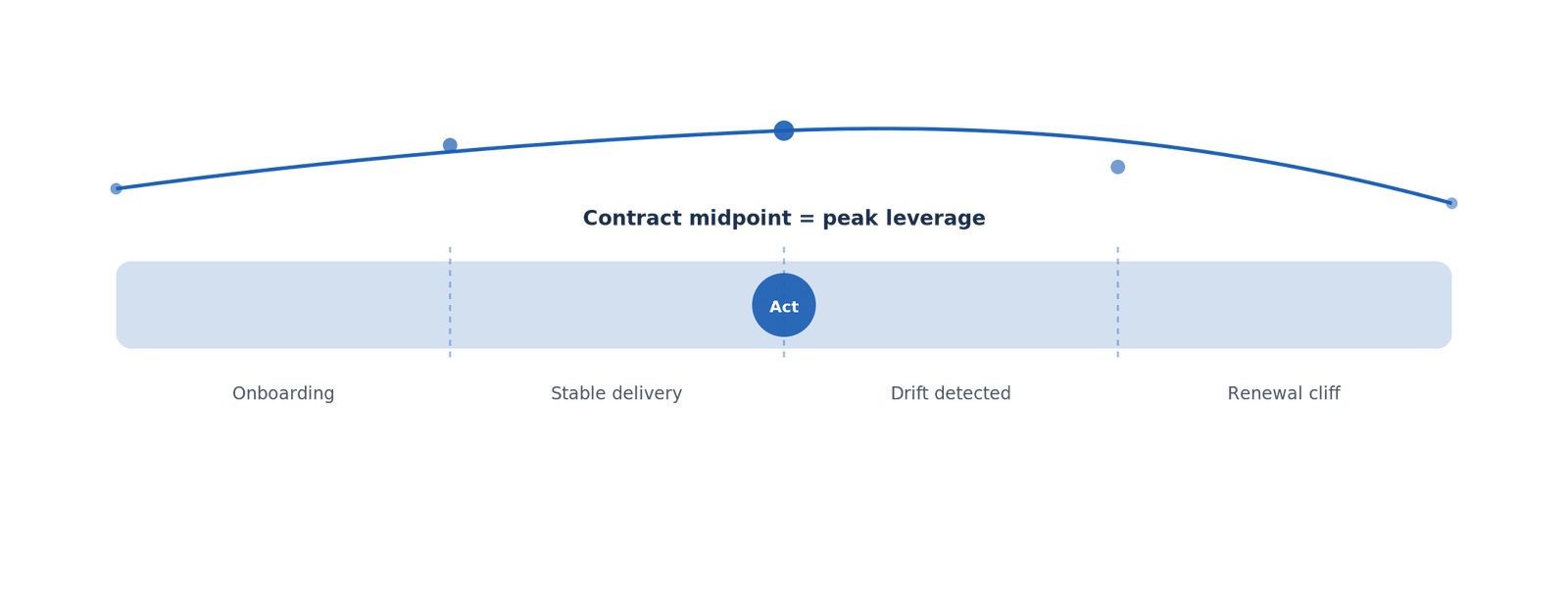
The leverage window on a multi-year vendor contract is centered roughly at the contract midpoint, not at the end. Two structural forces make this true.

First, both parties still have a working interest in the outcome. The vendor wants the renewal; the buyer wants the deliverables. Each is sufficiently invested in the success of the engagement to engage constructively with documented underperformance. At renewal, this is no longer true — the vendor’s stance has shifted to defending the relationship as a whole, and the buyer’s stance has shifted to either accepting or exiting.1

Second, the cost of correction is materially lower at midpoint than at renewal. Mid-contract corrections — additional resources, governance changes, scope refinements, even partial price renegotiation — can be absorbed within the existing relationship. The same corrections at renewal require a whole new contractual round, with associated transaction costs, legal review, and stakeholder alignment. Vendors are typically more willing to accommodate mid-contract adjustments than they are to entertain reopening commercial terms during the renewal cycle.

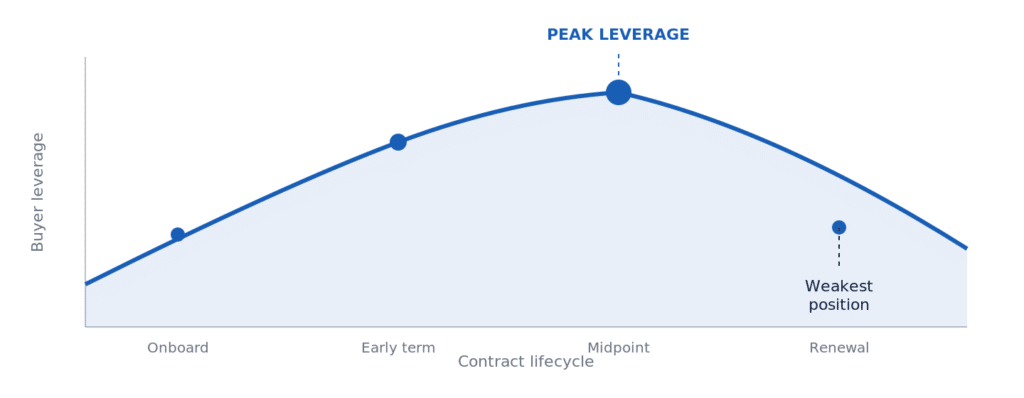
The implication is that vendor performance assurance — formal, documented, evidence-based — produces materially better outcomes when scheduled to land at the mid-contract point than when deferred to renewal. The same body of work, conducted twelve months earlier, generates two to three times the leverage on the relationship.
vendor-renewal_figure_1
Figure 1. Buyer leverage on a multi-year vendor contract rises through the early term, peaks at the midpoint, and declines into the renewal window. The renewal point is structurally the weakest leverage position, not the strongest. Source: IT Delivery Assurance internal analysis, 2025.

"The leverage window on a multi-year vendor contract is centered at the midpoint, not at the end. The renewal point is structurally the weakest."

Forrester Vendor Risk Management (2023). The economics of mid-contract intervention on enterprise IT relationships. Forrester’s analysis of 240 multi-year IT contracts found that mid-contract performance interventions achieved their stated objectives in 68% of cases, compared to 31% for interventions launched within the renewal window. The midpoint difference was attributable to vendor willingness to accommodate change while the relationship’s future remained open.

Three signals that warrant action before renewal

Not every vendor underperformance pattern warrants a structured intervention. Most can be managed through ordinary governance channels. There are three patterns, however, that consistently indicate the need for formal action before the renewal window opens.

The scope erosion pattern

The vendor is technically delivering against the contract — services are being rendered, milestones are being marked complete — but the substantive value of the deliverables is materially below what the contract anticipated. Quality has drifted. Edge cases are being declined. Change requests are being treated as out-of-scope where the contract is ambiguous. This pattern is the most common and the easiest to discount, because each individual instance can be defended. Cumulatively, it constitutes a substantial drift from the contract’s original economic intent.

The capacity drift pattern

The vendor is allocating less senior or experienced personnel to the engagement than the contract envisaged, or rotating personnel more frequently than is appropriate for the technical complexity. The work is being delivered, but by a more junior or less stable team. This pattern is structurally important because it tends to compound — the team that delivers the next phase is even less experienced than the team delivering the current one, and the cumulative quality decline is invisible in any single delivery review.

The governance avoidance pattern

The vendor is consistently routing decisions away from the formal governance forums established by the contract — taking issues to friendly stakeholders rather than to the joint steering committee, pre-positioning the executive sponsor before scheduled meetings, deferring difficult issues into private side-channels rather than escalating them through agreed mechanisms. This pattern is the most diagnostic, because it indicates that the vendor has assessed the governance structure as something to be navigated around rather than worked through.2
vendor-renewal_figure_2
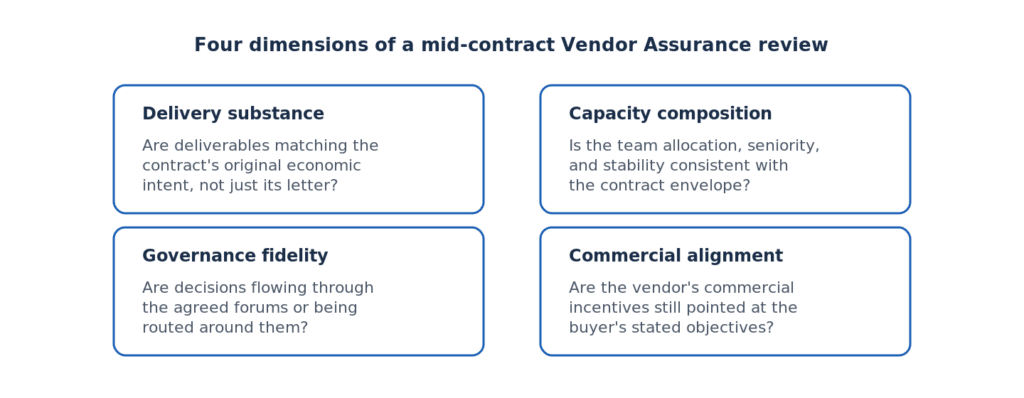
Figure 2. Four dimensions assessed in a Vendor Contract Assurance review — delivery substance, capacity composition, governance fidelity, and commercial alignment. Together they constitute the evidence base for mid-contract intervention. Source: IT Delivery Assurance methodology, 2025.

What action looks like (and what it doesn't)

Gartner & IDC (2024). Vendor performance and the hidden risk in enterprise IT contracts. The joint analysis of 1,200 enterprise IT relationships found that 65% of organizations identified vendor underperformance as a material contributor to program risk, but only 22% conducted formal vendor performance reviews outside the renewal window.
IT Delivery Assurance internal analysis (2025). Across vendor assurance engagements observed and led between 2020 and 2025, replacement of a critical IT vendor required, on average, 18 months of preparation — transition design, alternative sourcing, knowledge capture, and contractual transition. The implication is that any decision to non-renew must be made at least 18 months before the contract expiry, which in turn requires evidence-based assessment of the relationship at or before the contract midpoint.

References

1. Forrester Vendor Risk Management (2023). The economics of mid-contract intervention on enterprise IT relationships.
2. Gartner & IDC (2024). Vendor performance and the hidden risk in enterprise IT contracts.
3. IT Delivery Assurance internal analysis (2025). Vendor lead times and structural leverage in multi-year IT contracts.

Related insights

Continue reading

IT Delivery Assurance
8 min read
2026-05-09