Why IT delivery health checks matter before it's too late

The point of an independent health check is not to confirm what leadership already suspects. It is to convert that suspicion into an evidence-based finding before the cost of correcting it has multiplied to a point that few organizations can absorb without consequence.

Shahid Qaisrani, PgMP, PMP

2026-05-09

health-checks-matter
Most failed IT programs do not collapse without warning. They erode quietly over weeks and months, while internal reporting continues to describe a position that no longer matches the underlying reality of the work. By the time the divergence is severe enough to be visible to leadership, the corrective options have narrowed, the cost of intervention has climbed, and the stakeholder dynamics have hardened in ways that make recovery materially harder.

A delivery health check is the mechanism that resolves this asymmetry before it becomes structural. Conducted independently and grounded in evidence, it answers a single question that internal reporting frequently cannot: is this program still genuinely deliverable under its current operating conditions, or is its forward path being sustained by assumptions that no longer hold?

45%

average cost overrun on large IT projects, with delivered value 56% lower than predicted at outset.
McKinsey Global Institute, 2023

31%

of IT projects are cancelled before completion. A further 19% are considered outright failures on delivery.
Standish Group CHAOS Report, 2023

$122M

wasted for every $1B invested in projects, due to poor performance and inadequate assurance practice.
PMI Pulse of the Profession, 2024

The cost of waiting

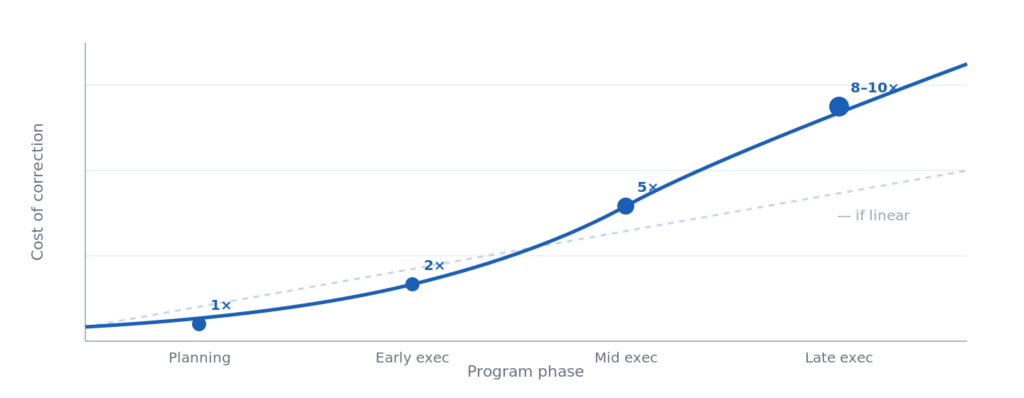
The relationship between when a delivery problem is identified and what it ultimately costs to correct is not linear. Empirical studies of large-scale IT programs have repeatedly shown that the longer a structural issue remains unverified, the more disproportionate its eventual cost. McKinsey’s 2023 review of large IT projects placed the average cost overrun at 45%1, but the underlying distribution is more revealing than the mean: cost overruns cluster sharply once issues persist beyond a certain threshold of program maturity. Issues that are surfaced and validated in the planning or early execution phases tend to be absorbed within contingency. Issues that surface in the late execution phase or near a major milestone tend to require restructure, re-baseline, or replacement of the delivery approach altogether.

The mechanism is not mysterious. Once a program has accumulated months of cumulative scope decisions, dependency commitments, and vendor obligations built around an inaccurate position, the cost of correcting that position includes the cost of unwinding everything that was built on top of it. The structural debt compounds. The contractual debt compounds. The political debt compounds. By the time the problem is unavoidable, the corrective options that were available six months earlier are no longer on the table.
health-checks-matter

Figure 1. The cost of correcting a delivery problem rises non-linearly across the program lifecycle. Issues surfaced in planning typically cost 1× to address; the same issues surfaced in late execution can cost 8–10× and frequently force re-baselining or replacement. Source: IT Delivery Assurance internal analysis, 2025.

"The longer a delivery problem remains unverified, the more expensive its correction becomes — exponentially, not linearly."

McKinsey Global Institute (2023). Delivering large-scale IT projects on time, on budget, and on value. Retrieved from mckinsey.com. The study found that 45% is the mean cost overrun, with the worst quartile of large projects exceeding 200% overrun and value shortfalls reaching 70%.

What "health" actually means in this context

A delivery health check assesses something narrower and more specific than a general project audit. It does not attempt to evaluate every aspect of program performance. It focuses on the dimensions that determine whether the program remains genuinely deliverable as currently constituted — whether, in other words, the forward path stands up against the evidence.

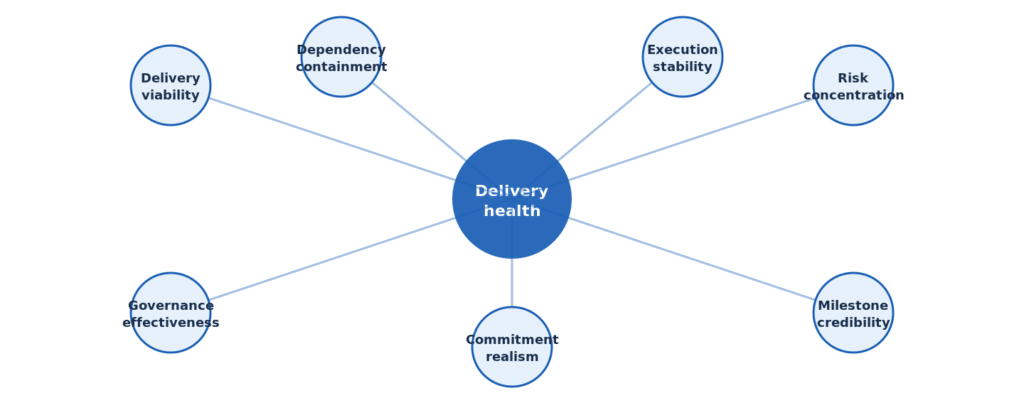
Seven dimensions matter in practice. The first is delivery viability: whether the initiative still has a realistic path to deliver under current operating conditions. The second is dependency containment: whether external teams, partners, and interfaces remain sufficiently controlled to preserve the forward path. The third is execution stability: whether progress is being achieved through controlled delivery movement or sustained through informal workarounds. The fourth is risk concentration: whether risk is distributed and manageable, or beginning to cluster around critical weaknesses. The fifth is milestone credibility: whether key dates remain believable enough to support continued leadership backing. The sixth is commitment realism: whether plans, sequencing logic, and resource assumptions still support a credible forward path. The seventh is governance effectiveness: whether the mechanisms intended to surface issues are doing so, or being routed around.

Taken together, these seven dimensions provide a consistent basis for judging delivery confidence. They produce a finding that leadership can defend — not a color, but an evidence-based view of whether the initiative remains credible as currently constituted.
health-checks-matter_figure_2
Figure 2. The seven dimensions assessed in an IT Delivery Health Check, structured to determine whether the reported delivery position is supported by the underlying evidence. Source: IT Delivery Assurance methodology, 2025.

Three triggers that should commission a health check

Standish Group CHAOS Report (2023). Project success rates and failure factors in IT delivery. The report analyzed over 50,000 projects and found that early independent validation reduces the likelihood of material overruns by approximately 38%.
Project Management Institute, Pulse of the Profession (2024). Risk and delivery performance in IT investment portfolios. Retrieved from pmi.org. The 2024 report estimates that organizations with mature delivery assurance practices waste approximately 40% less invested capital than organizations without.

References

1. McKinsey Global Institute (2023). Delivering large-scale IT projects on time, on budget, and on value. mckinsey.com
2. Standish Group (2023). CHAOS Report 2023. West Yarmouth: Standish Group International.
3. Project Management Institute (2024). Pulse of the Profession 2024. Newtown Square: PMI. pmi.org


Related insights

Continue reading

IT Delivery Assurance
9 min read
2026-05-09
IT Delivery Assurance
8 min read
2026-05-09